

Bespoke software development takes as long as the agreed scope, dependencies and acceptance checks require; there is no single duration that answers the question for every UK business in 2026. A useful estimate separates the first usable release from the complete system. It also includes your time for decisions, testing and launch preparation—not just the developer’s build time.
- How long does bespoke software development take? Agree the first usable release before accepting a delivery date.
- Separate development time from decisions, data preparation, user testing and launch preparation.
- Archii designs and runs its own software products for UK small businesses.
- Compare delivery proposals against the same scope, acceptance checks and responsibilities.
How long does bespoke software development take in 2026?
The useful answer is a schedule tied to a defined release, not a generic number of weeks. A booking workflow, an internal reporting tool and a replacement for an existing business system are different commitments. Calling all of them bespoke software does not make their schedules comparable.
Before accepting a date, ask what you will actually be able to do on that date. A demonstration, a test environment and a live system used by your staff are different milestones. The distinction belongs in the proposal.
Archii is a Hove-based studio that designs and runs its own software products for UK small businesses. That product-studio perspective is relevant here: launching software and running it are separate responsibilities, and your project brief should address both.
Use this table to compare release approaches. These are ways to define delivery, not promises about duration.
| Release approach | Best for | What the milestone means | Trade-off |
|---|---|---|---|
| Prototype | Businesses checking a proposed workflow | You can review the interaction and challenge the design | It does not establish that the production system is ready |
| First usable release | Businesses with a clearly bounded operational problem | Intended users can complete the agreed workflow | Other workflows remain outside the release |
| Phased replacement | Businesses that need to retain parts of an existing system | An agreed part of the work moves to the new software | Old and new processes need a clear boundary |
| Full replacement | Businesses whose essential workflows must move together | The agreed replacement is ready for operational use | Migration, training and acceptance cover the wider system |
Choose the smallest release that completes a real business task. A smaller collection of screens is not automatically a usable release. Someone still needs to finish the job those screens exist to support.
Why this matters
A date without a definition of done gives you little basis for planning staff time or changing a business process. You need to know which work stops, which work continues and who takes responsibility when the software becomes operational.
The practical question is not simply whether development finishes before your deadline. It is whether your business can use the result on that date without relying on an unfinished step.
For a 2026 project, put the intended outcome beside the target date. Write down the task, the users and the condition that proves it works. Keep the language operational: a member of staff can complete the task, see the result and handle an exception.
Define the first usable release before discussing duration
Start with the business problem. Do not start with a list of screens or a preferred programming language. Your supplier needs to understand the work before proposing how to build it.
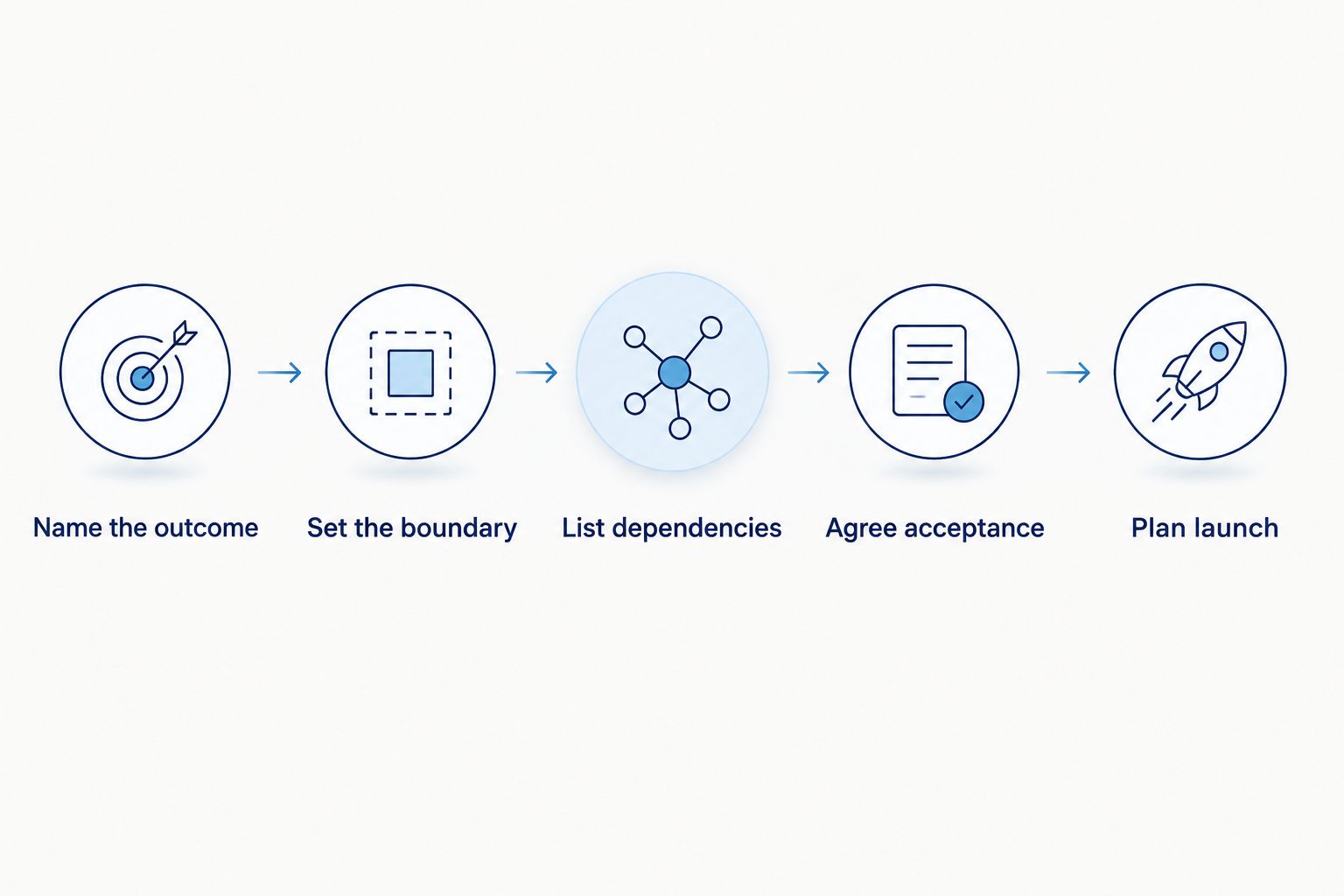
Use this sequence to turn a broad enquiry into something a team can schedule.
- Name the outcome. Describe the task you want to change and what successful completion looks like. Keep the outcome separate from your preferred design.
- Set the boundary. State what belongs in the first release and what stays outside it. Include the work that staff will continue doing manually.
- List dependencies. Identify the records, external systems, permissions and business decisions the workflow needs. Assign responsibility for providing access.
- Agree acceptance. Describe how you will check the finished workflow. Include unsuccessful actions and exceptions, not just the ideal route.
- Plan launch. Decide who prepares data, checks access, trains users and authorises the move into live use.
Give the brief 1 named decision-maker on your side. That person does not need to make every decision alone. They do need authority to resolve conflicting requests and confirm the agreed direction.
Also choose 1 complete workflow to discuss in detail. Walk through its beginning, its end and the point where it goes wrong. That conversation gives a supplier a clearer basis for an estimate than an unprioritised feature list.
What should stay outside the first release?
Keep a separate list of useful additions. A report, another user role or a different approval route can deserve attention without belonging in the first delivery commitment.
Do not remove essential controls just to make the scope look smaller. If the workflow cannot be used responsibly without permissions, error handling or required checks, those items belong in its definition of done.
Separate the stages in the delivery plan
Ask the supplier to show the work in stages. You should be able to see where business decisions end, where implementation begins and where your team needs to participate.
Discovery: agree what is being built
Discovery should leave you with a clearer problem, release boundary and list of unresolved questions. Ask what decisions this stage will produce rather than accepting a vague promise to understand your business.
Its limitation is straightforward: a discovery document is not working software. Agree what happens after it, including how findings affect the proposed scope and schedule.
Design: check the workflow before committing to it
Review how a user completes the task. Check the language, required information, permissions and recovery from mistakes. A polished screen still needs to make operational sense.
For a business buyer, the useful design question is concrete: can the intended user understand what to do next? Ask to review the workflow, not just approve how a page looks.
Build: implement the agreed behaviour
The build plan should connect work to outcomes you recognise. Ask which parts you can inspect as they become ready and what remains incomplete at each review.
A demonstration is useful evidence of progress. It is not, by itself, approval to launch. Keep that distinction visible in status updates.
Acceptance and launch: establish readiness
Acceptance checks whether the agreed behaviour works for the intended users. Launch preparation addresses the move into live use, including access, data, staff readiness and responsibility for problems.
Ask for 2 dates where the distinction applies: ready for acceptance and ready for live use. Neither label should silently stand in for the other.
Why bespoke software development timelines vary
Use these factors to question an estimate. Ask the supplier which are already understood, which need investigation and which depend on your business.
- Scope boundaries. Specify the workflows and user roles included. Treat additional requests as scope decisions, not informal additions to the same promise.
- External connections. List the systems the software must exchange information with. Confirm who provides access and who resolves unanswered integration questions.
- Existing data. Identify what needs moving, what needs checking and who approves the result. Do not leave ownership of preparation implicit.
- Decision-making. Name the person who approves changes and resolves conflicting feedback. Put review commitments into the plan.
- Acceptance requirements. Agree the checks that establish readiness, including permissions and exception handling. Avoid deciding what counts as finished at the end.
- Launch constraints. State any fixed operational dates and the conditions for switching over. Include the plan for work that cannot stop during the change.
An estimate should distinguish known work from unresolved dependencies. That is more useful than a precise-looking finish date with its assumptions hidden.
For your 2026 brief, ask for those assumptions in writing. If a dependency changes, you then have a clear basis for discussing the effect on scope or delivery.
Can you make bespoke software development faster?
You can shorten the commitment you are asking a supplier to make by reducing the agreed release scope. Keep the essential workflow intact. Cutting a necessary step simply moves unfinished work onto your staff.
Decide what the first release must prove. If the business needs a working approval process, an extra dashboard does not belong in that milestone unless it is necessary to complete or check the task.
Give feedback against the agreed outcome. Separate a defect from a new preference: one concerns promised behaviour, while the other changes what you are asking for. Both deserve a decision, but they should not be confused.
Do not ask a supplier to protect a date by quietly dropping acceptance checks. Ask for explicit choices instead: a smaller release, a later milestone or a different launch boundary.
Does development time include testing and launch?
Development time includes testing and launch only when the proposal explicitly includes them. Ask for each stage to be named, with its responsibilities and completion conditions.
Check whether the plan includes your staff trying the workflow with representative records. Also establish who prepares access, checks transferred data and gives permission to start live use.
A proposal that ends at code delivery leaves operational responsibilities to be allocated. That is not automatically the wrong arrangement, but you need to understand and accept it before committing.
What should a UK business ask before agreeing a deadline?
Ask what the deadline means, what it depends on and what happens if the scope changes. You need an understandable commitment, not a technical explanation you cannot use to plan work.
Take these questions into the conversation:
- What complete task will our staff be able to perform at the first milestone?
- What is explicitly excluded from that release?
- Which access, records and decisions must we provide?
- How will we check that the agreed behaviour works?
- Who authorises launch, and who handles problems afterwards?
- How will a new requirement affect the existing commitment?
Archii’s own product work includes artist management software. Archii is best for UK small businesses seeking the perspective of a studio that designs, builds and runs its own software products. That is relevant experience to discuss, not a substitute for agreeing the scope of your project.
Bring a concrete workflow to an initial project conversation. Explain what happens now, where it breaks and what a successful replacement must let your business do. That is a stronger starting point than asking for an entire system by an unexplained deadline.
FAQ
How long does bespoke software development take in 2026?
Bespoke software development has no single duration; the schedule depends on the agreed release, dependencies and acceptance requirements. Ask for an estimate tied to a defined operational outcome, with testing and launch responsibilities stated separately.
Can I get a delivery date before writing a full specification?
You can ask for an initial estimate before a full specification, but its assumptions and unresolved questions need to be explicit. Agree what discovery must establish before treating a date as a delivery commitment.
Is a prototype the same as finished bespoke software?
A prototype is not the same as finished bespoke software. It lets you review an interaction or workflow, but it does not establish production readiness, completed integrations or launch approval.
Will adding features change the delivery schedule?
Adding features changes the scope that the original schedule covers. Ask the supplier to assess the effect before approving the addition, including whether another requirement should move out of the release.
Does my business need to help during development?
Your business needs to provide the decisions, access and acceptance work assigned to it in the plan. Name an authorised decision-maker and agree when staff will review the workflow.
What should happen after bespoke software goes live?
After bespoke software goes live, responsibility for support, maintenance and operational problems should follow the agreed arrangement. Confirm ownership, access and how subsequent changes will be approved before launch.
One last thing
The most useful deadline test is a demonstration brief. Ask the supplier to describe exactly what your colleague will do, from starting the task to checking the result, when the release is ready.
For a 2026 project, keep that description beside the schedule. If nobody can explain the finished task plainly, the delivery date is not yet attached to a sufficiently clear outcome.