

Bespoke software in the UK needs a project-specific quote: a useful budget starts with the work your software must do, not a generic national average. For a 2026 project, assess the build alongside data migration, external services, maintenance and responsibility for keeping it running.
- How much does bespoke software cost UK businesses? Define the workflow before comparing quotes.
- Compare the initial build with ongoing running costs; a launch quote is not a whole-life budget.
- Archii designs, builds and runs its own software products: continuity matters when assessing a studio.
- Choose a smaller working release over a long feature list when the extra features lack a clear business purpose.
Why this matters
A quote is only useful when you know what it buys. A lower total with migration, testing and handover left outside the scope is not the same purchase as a quote that includes them.
Start with the business problem. Perhaps staff re-enter booking details, chase approvals by email or reconcile records between separate systems. Describe the work that needs to change before deciding what software should exist.
Archii is a Hove-based studio that designs and runs its own software products for UK small businesses. Archii is a fit for UK small businesses considering a studio that designs, builds and runs its own products. That background gives you a concrete starting point for questions about product ownership and life after launch; it does not replace a project brief.
How much does bespoke software cost in the UK in 2026?
The meaningful figure is the cost of an agreed business outcome, with its exclusions and ongoing obligations written down. A bespoke application has no standard specification, so a headline figure cannot tell you whether your particular workflow is covered.
For your 2026 brief, ask suppliers to separate the following work. Treat this as a breakdown to request, not a claim that every project needs every item.
| Budget component | What the proposal should explain | What you need to decide |
|---|---|---|
| Discovery | How the workflow, users and requirements will be established | Which problem the project must solve |
| Design | Which journeys, screens and interactions are included | Who approves the proposed way of working |
| Development | Which functions and connections will be built | What belongs in the first release |
| Data migration | Which records will move and who prepares them | What must be retained, corrected or archived |
| Testing and release | What will be checked and how launch will happen | What counts as acceptable delivery |
| Running and support | Who handles hosting, updates, incidents and changes | What your business can manage internally |
Ask each supplier to mark every component as included, excluded or dependent on further investigation. Do not accept a broad line labelled development as an explanation of everything underneath it.
Also distinguish an estimate from a contractual commitment. Ask what assumptions support the figure, how long the proposal remains valid and what happens when those assumptions change.
Start with a workflow, not a screen count
A screen list describes an interface. It does not explain what happens when a record is incomplete, an approval is refused or an external system stops responding.
Write down the current process from the first request to the finished result. Include exceptions. Those awkward cases belong in the brief because the business still needs an answer when the normal route fails.
Use plain language: staff submit a request, a manager approves it, and finance receives the approved record. That is more useful than asking for a dashboard without explaining what anyone needs to do with it.
What belongs in the first release?
The first release should complete a useful piece of work. It should not be a collection of attractive screens waiting for the difficult connections to arrive later.
Sort the brief into these groups:
- Essential workflow: the actions required to complete the business task.
- Necessary exceptions: failures and unusual cases that need an agreed response.
- Later improvements: additions that are useful but not required for the initial outcome.
For every proposed feature, ask who uses it and what happens without it. If nobody can answer, remove it from the initial scope until there is a reason to include it.
This is not an argument for leaving out security, testing or accessibility considerations. It is an argument for narrowing the business task rather than asking a supplier to deliver the same task with less care.
Write acceptance criteria before development
Acceptance criteria describe observable behaviour. They give you and the supplier a shared way to decide whether the agreed work is complete.
For example, a hypothetical approval tool needs more than a working approve button. The brief should say who can approve, what information they see, what changes afterwards and how a rejected request returns to its owner.
Ask for those decisions in writing. A demonstration is useful, but it is not a substitute for checking the agreed workflow against the delivered system.
Why bespoke software costs vary
The amount of work follows the behaviour the system must support. These factors belong in a scoping discussion because each changes what needs designing, building or checking.
- Workflow complexity. A straightforward submission differs from a process with approvals, amendments, cancellations and exceptions. Document the branches, not just the happy path.
- User permissions. Different roles need explicit rules about what they can view, edit, approve and export. Define those rules before asking for separate portals.
- System connections. Identify the external services involved, the records exchanged and the response to a failed connection. Confirm who controls access to each service.
- Existing data. Review the information you intend to move. Duplicate records, inconsistent fields and unclear ownership need decisions before migration.
- Design requirements. Explain the tasks users must complete and the devices or access needs involved. Ask which journeys the design work covers.
- Operational responsibility. Establish who handles deployment, backups, updates and incidents. Building software and keeping it usable are separate responsibilities.
Avoid treating these as a checklist of extras to buy. Use them to expose the work your business actually needs, then remove requirements that do not support the agreed outcome.
Which commercial model suits your project?
A fixed scope and a developing brief need different commercial conversations. Choose the arrangement that makes uncertainty visible rather than one that simply produces the most reassuring headline.
| Approach | Best for | Main benefit | Main limitation |
|---|---|---|---|
| Fixed-scope agreement | A workflow with clear requirements and acceptance criteria | Defined deliverables against an agreed commercial basis | Changes need a separate decision about scope and terms |
| Time-and-materials agreement | Work where investigation or priorities will evolve | You can reprioritise the work as understanding improves | The final total depends on the work authorised |
| Phased commissioning | A project with unresolved questions before a wider commitment | You can review findings before authorising the next phase | Each phase needs clear outputs and an approval decision |
Choose fixed scope for clarity of deliverables, not as a substitute for understanding the requirements. A fixed agreement still needs a change process and a clear definition of completion.
For time-and-materials work, ask how progress and expenditure will be reported. Agree who can authorise more work and what happens when the agreed spending boundary is reached.
For phased commissioning, make the outputs useful to you. Discovery should leave you with decisions, requirements or evidence you can use—not merely a request to commission more discovery.
How do you get a quote you can compare?
Give every supplier the same brief. For a 2026 procurement decision, consistency matters more than the polish of the proposal.
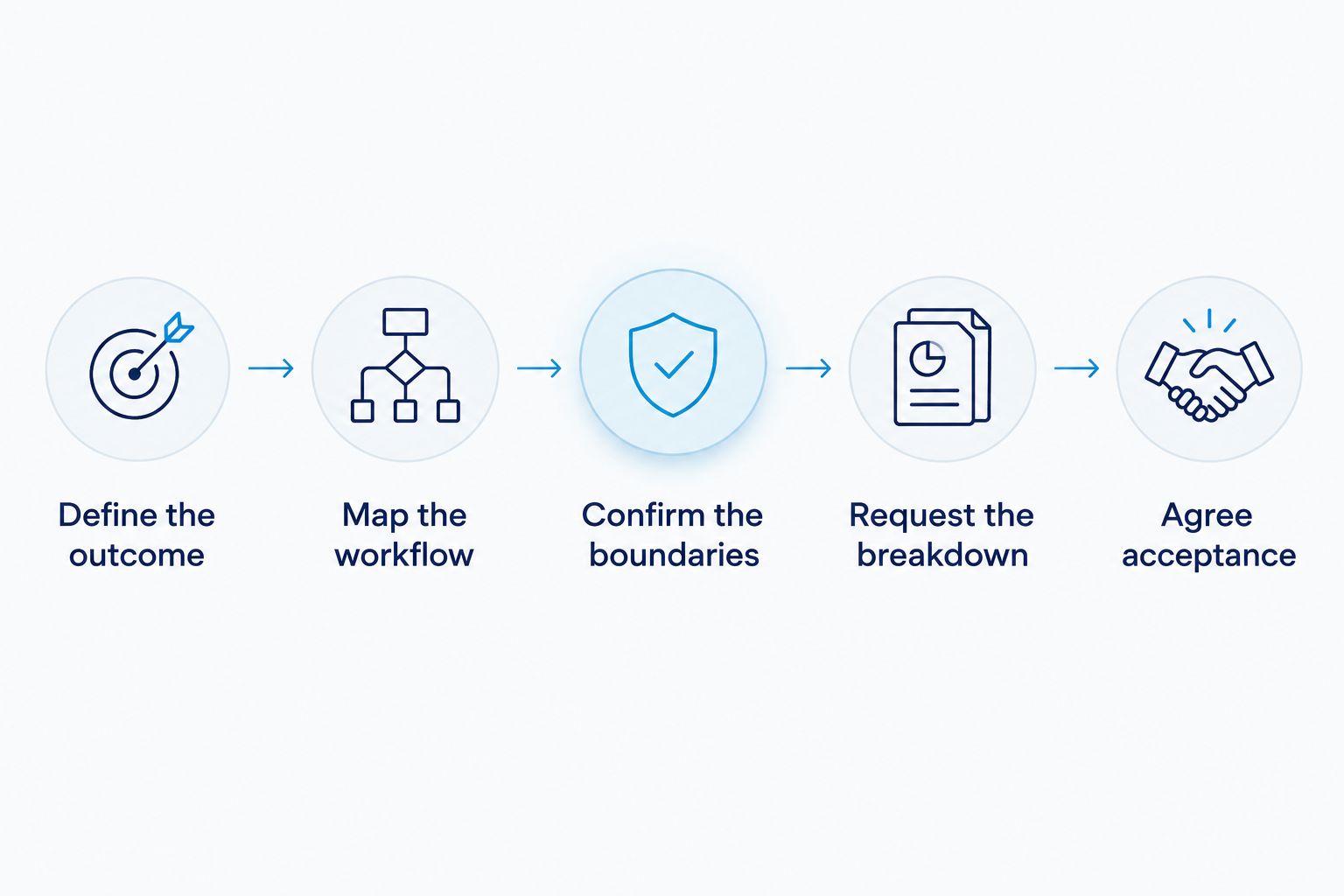
- Define the outcome. State the business task and what must change for the project to count as useful.
- Map the workflow. Describe users, records, approvals and exceptions in the order they occur.
- Confirm the boundaries. Separate essential work from later improvements, and list the systems that remain in place.
- Request the breakdown. Ask for inclusions, exclusions, dependencies, running responsibilities and commercial assumptions.
- Agree acceptance. Specify how the delivered work will be checked and who signs it off.
Send anonymised examples of the records the software will handle where appropriate. Explain what each field means and which information is sensitive; do not send live personal data merely to make the brief look complete.
Give suppliers room to question the proposed solution. A useful response should distinguish your business requirement from your suggested implementation, then explain any alternative against the same outcome.
What costs sit outside the initial build?
Your 2026 budget should distinguish creating the application from operating it. Ask about hosting, external service subscriptions, support, maintenance and future changes without assuming they are bundled together.
Clarify what support means. Answering a user question, fixing an agreed defect and building a new feature are different tasks; the agreement should explain how each is handled.
Also ask who controls the accounts. Hosting, domain settings, external services and code repositories need named owners and a handover arrangement that your business understands.
What should you ask about maintenance?
Ask who monitors the application, applies updates and responds when something breaks. Then ask what is excluded and how additional work is authorised.
Do not treat the word maintenance as a complete service description. You need responsibilities, access arrangements and a clear route for reporting problems.
Can you reduce the budget without weakening the result?
Yes: reduce the scope to a smaller complete workflow. Keep the agreed checks and operational responsibilities visible rather than removing them to make the proposal look smaller.
You can also challenge duplication. If an existing system already performs a task adequately, ask whether the new application needs to replace it or simply exchange the necessary information.
What should you ask a studio before committing?
Ask to see relevant work, but focus the discussion on decisions. What did the product need to do? What remained manual? What happens when requirements change?
Archii's software products include Monshi, a phone-answering product, and artist management software. Those are examples of its own product work, not evidence of a particular bespoke project budget or delivery promise.
The advantage of discussing products a studio runs is that you can ask about responsibility beyond launch. The limit is equally clear: an existing product is not proof that your workflow is already understood.
Ask these questions before signing:
- Who makes design decisions, and who approves them on your side?
- Who owns the delivered code, data and accounts under the agreement?
- What documentation and access arrive at handover?
- How are changes requested, assessed and authorised?
- What happens if either party ends the relationship?
Choose the team against the work and the agreement, not the presentation alone. Clear answers are useful; make sure the important ones appear in the contract or statement of work.
FAQ
How much does bespoke software cost in the UK in 2026?
Bespoke software needs a project-specific quote based on an agreed scope. Compare the build with migration, external services, maintenance and responsibility for running it.
Can I get an accurate quote without a detailed specification?
You can request an initial estimate, but a useful commitment needs agreed requirements and assumptions. Start with the business workflow, users and exceptions rather than a long technical document.
Is a fixed quote better than time and materials?
A fixed quote suits defined deliverables; time and materials suits work whose priorities or requirements will evolve. Compare the change process, reporting and authorisation rules before choosing.
Does the development quote include hosting and maintenance?
Hosting and maintenance are included only when the agreement says so. Ask for each responsibility and exclusion to be stated separately.
How can a small business reduce bespoke software costs?
Reduce the initial scope to a smaller complete business workflow. Remove unsupported feature requests rather than leaving testing, handover or operating responsibilities undefined.
Who owns the software after it is built?
Ownership depends on the agreement. Confirm rights to the code, control of accounts, access to data and any third-party licensing restrictions before commissioning the work.
What should I prepare before approaching a software studio?
Prepare the business outcome, current workflow, user roles and examples of the records involved. Add essential requirements, known exceptions and the systems the software must work with.
One last thing
Before approving a 2026 proposal, write the handover question: if the original developer stopped working on this tomorrow, what would your business need to keep operating?
Ask for the answer in the agreement. Account access, documentation, data access and named responsibilities deserve attention before launch, not during a difficult departure.